

An organization experiences operational friction, and leadership immediately decides to launch a new software system or restructure a department. While the instinct to act is understandable, rushing into implementation without a formal vetting process is the primary reason why corporate initiatives fail. Research indicates that a vast majority of enterprise projects do not deliver their expected value. To prevent wasting budget and frustrating teams, businesses must establish a standardized gatekeeping process.
A structured evaluation ensures that systems, processes, and personnel are prepared before major investments are approved. By implementing a standardized project readiness review, leaders can determine if a proposed initiative is actually ready for execution.
What is a project readiness review in business operations?

A project readiness review is a structured evaluation that checks if a team, plan, and system are fully prepared before moving to the next project phase or launch. Often referred to as a project readiness assessment, this process operates as an objective quality gate. Unlike traditional project management, which focuses on executing an already approved project, this review assesses whether the project should begin in the first place.
Before authorizing expenditures, leaders must determine if the proposed solution is the most effective path. Integrating this assessment into organizational governance allows companies to identify operational gaps early. For a broader strategic context on evaluating capital investments, read our executive guide on how to know if a project is worth it.
The core goals of a project readiness assessment

Implementing a standardized project readiness assessment helps organizations move away from speculative decision-making and transition to an objective, evidence-based review. This quality gate focuses on three primary objectives to secure the project foundation:
- Catching risks early: The review is designed to find hidden gaps in the budget, schedule, or technical design before they cause costly delays. Identifying these discrepancies during the planning stage is significantly less expensive than resolving them during implementation.
- Checking team skills: Advisors use the assessment to ensure that internal staff and operational leaders have the proper training, tools, and authority to complete their assigned tasks. Without the right personnel readiness, even the most advanced systems will fail to achieve adoption.
- Validating requirements: The process confirms that all technical and operational goals are met, documented, and mathematically aligned with the desired business outcomes.
By achieving these goals, a business establishes a reliable operational filter. To learn how these objectives integrate into a wider organizational framework, explore our specialized initiative validation services.
How to conduct a project readiness review in 5 steps
To establish a repeatable and objective gatekeeping system, organizations should follow a structured five-step methodology. This process ensures that every proposed initiative is analyzed with the same operational rigor.
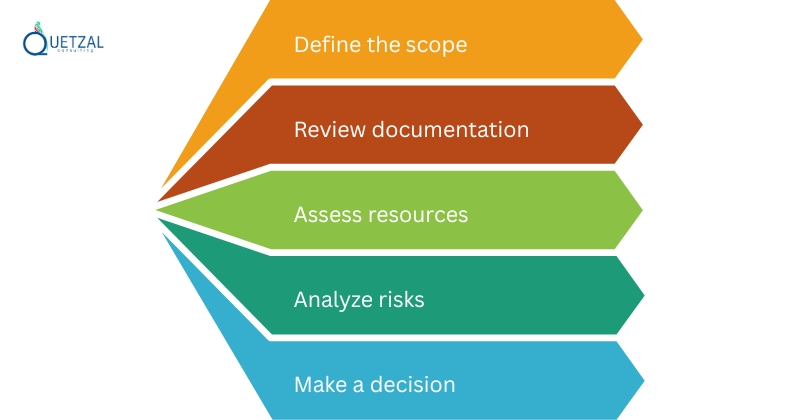
Define the scope
The first step requires the review team to decide what part of the project, workflow, or technology system they are testing. Clearly bounding the assessment prevents the evaluation from becoming too broad, allowing advisors to focus on critical operational dependencies and system integrations.
Review documentation
During this step, the assessment team evaluates all project charters, business cases, standard operating procedures, and safety rules. The goal is to verify that the requirements are clear, realistic, and free of contradictions before any developer or vendor is hired.
Assess resources
Organizations must verify funding levels, technological tools, and staffing availability. This step ensures that the personnel assigned to the project have the necessary bandwidth and are not already overallocated to daily operations.
Analyze risks
This phase involves listing potential roadblocks, technical bottlenecks, and organizational change barriers. For each identified risk, the team must design a practical backup plan to minimize operational disruptions during deployment.
Make a decision
The final step is to make an objective, data-backed recommendation. The evaluation team will either approve the project for launch, require specific operational gaps to be fixed before kickoff, or recommend delaying or canceling the project entirely.
The project readiness checklist: your framework for Excel or Word

A standardized evaluation requires a consistent tool to measure readiness across different departments. A project readiness checklist serves as the foundation for building a custom project readiness review template word document or a Project Readiness Checklist Template Excel sheet.
Below is the standard framework used by Quetzal Consulting to evaluate business initiatives before launch:
| Assessment Category | Evaluation Criteria | Verification Method | Status (Go / No-Go) |
|---|---|---|---|
| Strategic Alignment | The initiative resolves a documented root cause rather than a symptom. | Root cause analysis review | |
| Financial Feasibility | The budget contains a realistic contingency fund and clear ROI metrics. | Financial model audit | |
| Resource Bandwidth | Key team members have dedicated, scheduled hours for project tasks. | Resource capacity mapping | |
| Technical Readiness | System requirements are finalized, and data migration plans are validated. | IT architecture review | |
| Operational Training | End-users have a documented training schedule and adoption plan. | Training roadmap audit | |
| Risk Mitigation | A risk registry exists with clear mitigation owners for each item. | Risk workshop review |
Project readiness review sample: a practical business scenario
Reviewing a project readiness review sample helps clarify how these checklists prevent operational errors in real-world scenarios. In this project readiness review example, we look at a mid-sized Canadian financial services company planning to implement a new customer relationship management system.

The executive sponsor had already approved the software budget, and the implementation team was preparing for a kickoff next month. However, prior to signing the vendor contract, the operations director initiated a formal readiness check using our template.
The assessment revealed several critical operational gaps:
- The system integration requirements had not been verified with the legacy database manager.
- The customer support team, who would be the primary users, had not participated in the workflow design sessions.
- No budget had been allocated for training materials or post-launch support.
Based on the review, the decision was made to delay the project kickoff by three weeks. During this period, the team aligned the database integration requirements and established a training plan. By pausing to address these gaps, the company avoided paying licensing fees for an idle system and completed the launch with zero downtime.
Niche variations: project safety readiness review
Depending on the industry, the focus of a readiness assessment may shift to prioritize regulatory compliance and physical safety. In sectors such as construction, oil and gas, or manufacturing, organizations regularly perform a project safety readiness review.

While Quetzal Consulting focuses primarily on operational workflows, technological systems, and business process readiness, the fundamental logic remains identical. Whether checking if a software system is ready for data migration or if a physical site is ready for heavy equipment, the objective is to prevent costly errors by validating preparation before action.
Frequently asked questions about project readiness reviews
What is the difference between a project readiness review and a gate review?
A gate review typically focuses on project management metrics, such as whether a phase is on time and within budget. In contrast, a project readiness review evaluates operational feasibility, checking if the business operations and end-users are physically prepared to adopt the change.
How long does a project readiness assessment typically take?
The duration depends on the complexity of the initiative. A standard operational review can be completed in under 40 days, providing a clear path to value without causing unnecessary delays to the project timeline.
Can a project readiness review template be used for agile projects?
Yes. While agile projects release updates incrementally, running a simplified readiness assessment before launching major epics or migrating core databases ensures that the overall system architecture remains stable and user adoption is supported.
Elevate your project governance with Quetzal Consulting

To maximize the return on your capital, your organization must establish a reliable process to filter out unready initiatives. Quetzal Consulting partners with Canadian businesses to design custom project evaluation frameworks, audit resource capacity, and establish robust operational governance.
Whether you need to review a major system implementation or require fractional project leadership to guide your validated project to completion, our outcome-first approach ensures that your resources are focused on the highest-value initiatives. Sometimes, the assessment reveals that a major implementation is unnecessary, and that your goals can be achieved faster through targeted process improvement consulting.
Before you commit your capital to a new initiative, let our experts help you pressure-test your plan. Visit the Quetzal Consulting homepage to request a complimentary consultation and safeguard your capital with a professional project readiness review.