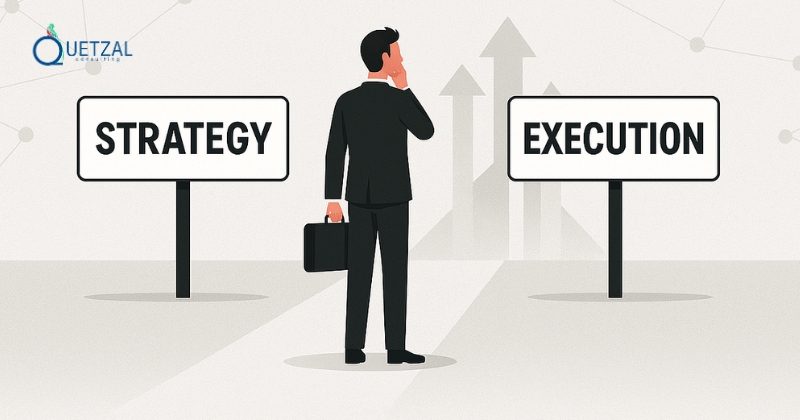
Every year, executive teams spend months—and often hundreds of thousands of dollars—crafting the perfect strategic plan. Yet, studies consistently show that between 60% and 90% of these strategic initiatives fail to meet their objectives. Why? The culprit is almost always the strategy execution gap.
The strategy execution gap is the persistent disconnect between an organization’s high-level goals and the actual results achieved on the ground. When good plans fail, it is rarely because the strategy itself was flawed; it is because the organization lacked the operational discipline to translate that vision into daily behaviors.
What causes the strategy execution gap?

Closing the gap requires an honest assessment of why your organization is failing to execute. Most businesses fall victim to one of these three core execution bottlenecks:
1. Lack of strategic clarity and translation
Strategy often remains an abstract document in the boardroom. If leadership fails to translate broad goals (e.g., “increase market share by 15%”) into specific actions and owners, employees cannot connect their daily work to the company’s objectives. When the front line does not understand the “why” behind their tasks, execution momentum dies immediately.
2. Organizational misalignment and silos
When departments operate in silos, they naturally prioritize their own local goals over enterprise objectives. Without strong horizontal alignment, teams end up pulling in different directions. For example, if Marketing is executing a high-volume lead strategy while Sales is executing a high-margin enterprise strategy, both teams will work incredibly hard but the overall company objective will fail.
3. Fragmented systems and delayed feedback
Strategic goals, KPIs, and daily project management tasks often live in completely disconnected tools. This creates “execution drift”—teams revert to old habits because the new strategy isn’t reinforced in their daily operating systems. Furthermore, relying on quarterly reviews to track progress is too slow. By the time leadership realizes a project is off-track, weeks of progress have been lost.
How to close the strategy execution gap

Moving from planning to effective execution requires building an “implementation architecture.” This is the core focus of operational execution support consulting.
Establish a unified operating rhythm
You must move beyond annual planning toward an iterative cycle of briefing, executing, and debriefing. Implementing weekly or bi-weekly check-ins tied directly to strategic KPIs allows teams to identify bottlenecks and risks before they become major failures.
Prioritize behavioral accountability
Execution is often treated as a reporting problem rather than a behavioral one. You must define what success looks like in terms of daily actions. Assign clear ownership for outcomes, ensuring that cross-functional dependencies are explicit. It is not enough to measure lagging financial indicators; you must track the leading behavioral metrics that signal whether the strategy is actually being adopted.
Choosing the right execution framework
There is no one-size-fits-all solution to closing the gap. Different organizations require different structural fixes. For some, standardizing OKRs provides the necessary focus. For others fighting through the “whirlwind” of daily operations, a system like 4DX is required. If you are unsure which structure fits your culture, read our comparison on business execution frameworks.
Frequently Asked Questions
Who is responsible for closing the strategy execution gap?
While the CEO owns the strategy, the execution gap is usually closed by a dedicated operations leader (like a COO) or an external execution consultant who can objectively align the departments and enforce governance.
How long does it take to fix execution issues?
Fixing systemic execution issues is a cultural shift. While you can implement a new reporting rhythm in a few weeks, it typically takes 3 to 6 months for the organization to fully adopt the new behaviors and start hitting targets consistently.
Stop watching your best strategic plans die on the vine. If you are struggling to close the strategy execution gap, contact Quetzal Consulting today to build a disciplined, predictable execution engine for your business.